
How it Works

The eWell Puck is a unique source of energy designed to work with the body at a fundamental level.
It emits a penetrating field of energy waves in the far-infrared spectrum. This energy interacts with the water within the body and supports cellular function. Its principal method of action appears to be through its effect on water, while additional mechanisms associated with far-infrared energy may also play a role.
The result is a remarkably simple biohack with applications for humans, horses and pets.
Users consistently report improved sleep and hydration, reduced anxiety, pain and inflammation, increased energy, greater physical freedom and faster, more complete recovery.

A Unique Energy Source
The eWell Puck generates its energy through a unique combination of materials and specialized manufacturing processes, supported by regular grounding.
This is a new and unconventional technology, and there is still much to learn about exactly how it works. What is clear is that the combination produces a persistent far-infrared energy field without batteries, electronics or an external power source.
The eWell is always working.
And there is another important component: shungite.
The eWell Puck contains shungite, a carbon-rich natural material long associated with electromagnetic protection. Within the eWell system, it serves as part of the protective side of the technology—helping to disrupt and shield against unwanted, non-native electromagnetic influences.
Modern life has surrounded us with these influences. Cell phones, computers, Wi-Fi, smart watches and modern lighting are everywhere. Schools, universities, hospitals, offices, gyms, convention centers and even coffee shops can expose us to a constant accumulation of artificial electromagnetic energy and artificial light.
We are only beginning to understand what living in this environment means for the human body and the animals who share it with us.
The eWell is designed to provide a simple answer: support the body’s natural energy while helping protect it from unwanted environmental energy.
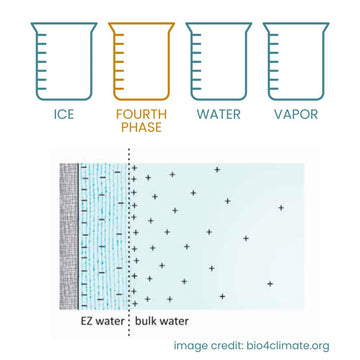
A Connection with Water
One of the most intriguing developments in our understanding of water comes from the work of Dr. Gerald Pollack of the University of Washington.
Pollack has extensively investigated what he calls the fourth phase of water, or EZ (exclusion-zone) water. His work describes water behaving in ways very different from the simple H₂O model we learned in school.
In this fourth phase, water develops a separation of electrical charge, creating distinct positive and negative zones. Pollack proposes that this charge separation creates a reservoir of usable energy—a biological “water battery.”
This offers a fascinating new way to think about where some of the energy of life comes from.
Yes, we obtain energy from food. But our bodies are also made largely of water, and according to Pollack’s model, that water can function as an energy-storage system in its own right.
And like any battery, it needs to be charged.
Light Charges the Water Battery
Pollack’s research has demonstrated that light can promote the formation of exclusion-zone water, with infrared wavelengths being particularly important.
This is where the eWell Puck enters the picture.
The eWell produces far-infrared energy continuously. In effect, it can be thought of as a personal, wearable trickle charger for the body’s water battery.
It doesn't need to be plugged in.
It doesn't need to be recharged.
It doesn't run out of power.
It simply works.

What Happens When the Battery Runs Low?
We all recognize what happens when a battery loses its charge: performance declines.
The human body can be thought of in much the same way.
Dehydration, aging and physical stress are all associated with diminished energy and declining physical performance. When the body’s water systems are not adequately supported, the effects can show up as fatigue, poor sleep, anxiety, reduced freedom of movement, inflammation, discomfort and slower recovery.
So ask a different question:
What if part of maintaining vitality is keeping the body’s water battery charged?
That is the principle behind the eWell.
The eWell to the Rescue
The eWell Puck takes a two-part approach.
First, it helps charge the body’s water battery.
Its far-infrared energy interacts with the water within the body, supporting the fourth-phase water system described by Pollack. The same basic physiology applies to horses and pets, making the eWell relevant not only to us, but to the animals we love.
Second, it helps protect that system.
The eWell incorporates shungite as part of its shielding technology, helping to disrupt and block unwanted, non-native electromagnetic influences and artificial light.
In other words, the eWell is designed to charge and protect.
Charge the water battery.
Protect the water battery.
Support the cellular environment.
And do it continuously, without batteries, electronics or complicated routines.
A New Way to Think About Wellness
The eWell Puck represents a different approach to wellness—one based not on adding another drug, supplement or complicated protocol, but on supporting the body’s own energy systems.
At its heart is a simple idea:
Water is not merely something the body needs. It may also be one of the body’s most important energy systems.
The eWell Puck is designed to work with that system.
For people.
For horses.
For pets.
Charge the water. Protect the water. Support the life within it.

Additional Reading
What Is The Forgotten Side of Water? A Midwestern Doctor writes on Substack
“One of the fascinating things about science is that while it is an excellent tool for discerning the nature of reality, it will simultaneously refuse to look at data with implications that challenge the existing scientific orthodoxy. So an unfortunate situation is created where science advances knowledge to a point but then reverses polarities and paradoxically becomes a barrier to that advancement.
An excellent illustration of this dynamic can be seen with water, and as a result, many of its properties are relatively unknown. One of the most important properties is that provided ambient infrared energy is present in the environment and a polar surface exists, water can assume a semi-solid state where it behaves like a liquid crystalline structure. Since a significant portion of the water within the body is in the liquid crystalline state, the biological consequences of this water, in my eyes, represent a key forgotten side of medicine.
In the first part of this series, I discussed the long lineage of scientists who have studied this semi-solid form of water, followed by listing some of the key properties of this gel-like 4th phase of water and what causes it to form. Since it has been studied by so many, it has many names (e.g., interfacial water or EZ water) and hereafter will be referred to as liquid crystalline water, which I believe is the most accurate description for it.”
~A Midwestern Doctor
Regarding “Zeta Potential” & Circulation
“The second key factor governing flow in the body is liquid crystalline water, something observed by many throughout the centuries and scientifically quantified by Gerald Pollack. When water has a negatively charged surface and a source of ambient energy (which is typically infrared light—something all around us and also constantly produced by the body), water will transition from free H2O to a connected network of H3O2 that behaves like a semisolid and is best described as a liquid crystal.
Since hydrogen atoms need to be removed from the liquid crystalline water to make this transition occur (H3O2 is H1.5O2, not H2O), they are found in a high concentration near the H3O2. Conversely, since the H3O2 has a semisolid structure, it will push everything else out and not allow anything to pass through it (leading to its boundary often being referred to as an “exclusion zone”). This includes the displaced hydrogens, which in contrast to the negatively charged H3O2 carry a positive charge.
There are a variety of significant effects of liquid crystalline water. First and foremost, it creates much of the structure and stability of the body all the way down to the insides of each cell. Secondly, it creates barriers that allow each surface within the body to slide frictionlessly against each other, protects cells from external damage, and maintains cellular integrity by preventing things from passing throughout. The lining of your blood vessels (the endothelium—which is coated with liquid crystalline water), for example, requires all of these to function, and one of the reasons the spike protein is so damaging is because of its ability to penetrate the protective layer which covers the endothelium. Lastly, it functions as an energy source that facilitates a variety of physiologic functions.
One of the most important functions of liquid crystalline water is that when it surrounds normal water as a tube, it creates spontaneous motion of that water from one end of the tube to the other. Many different organisms depend on a vast number of fluid movements inside of them. Still, in many cases, there is either no identified source for that motion, or the postulated source cannot account for all the motion observed. However, in each case where it is possible to assess the fluid vessel in question, a lining of liquid crystalline water is found surrounding it, and the vessel is structured so that the direction of flow of liquid crystalline water would be expected to create is what is observed.
